
The Battle of Berlin (April 16 – May 2, 1945)
The Battle of Berlin, the culmination of the Berlin Offensive, was one of the most intense and bloody battles of World War II. It took place from April 16 to May 2, 1945, and its goal was to capture the capital of the Third Reich and to finally defeat Nazi Germany.
Preparations and the Beginning of the Offensive
- Forces Involved:
- Red Army: approximately 2.5 million soldiers, supported by thousands of tanks, aircraft, and artillery.
- German Wehrmacht: approximately 1 million soldiers, including remnants of regular units, Volkssturm (people’s militia), and Hitler Youth.
- Commanders:
- Red Army: Marshals Georgy Zhukov (1st Belorussian Front) and Ivan Konev (1st Ukrainian Front).
- Germany: Generals Gotthard Heinrici and Helmuth Weidling.
- Beginning of the Offensive: On April 16, 1945, after a massive artillery preparation, the Red Army began its offensive, crossing the Oder and Lusatian Neisse rivers.
Course of the Battle
- Breakthrough of the Defense Lines: The Soviet troops, facing fierce resistance, gradually broke through successive German defense lines, particularly in the Seelow Heights.
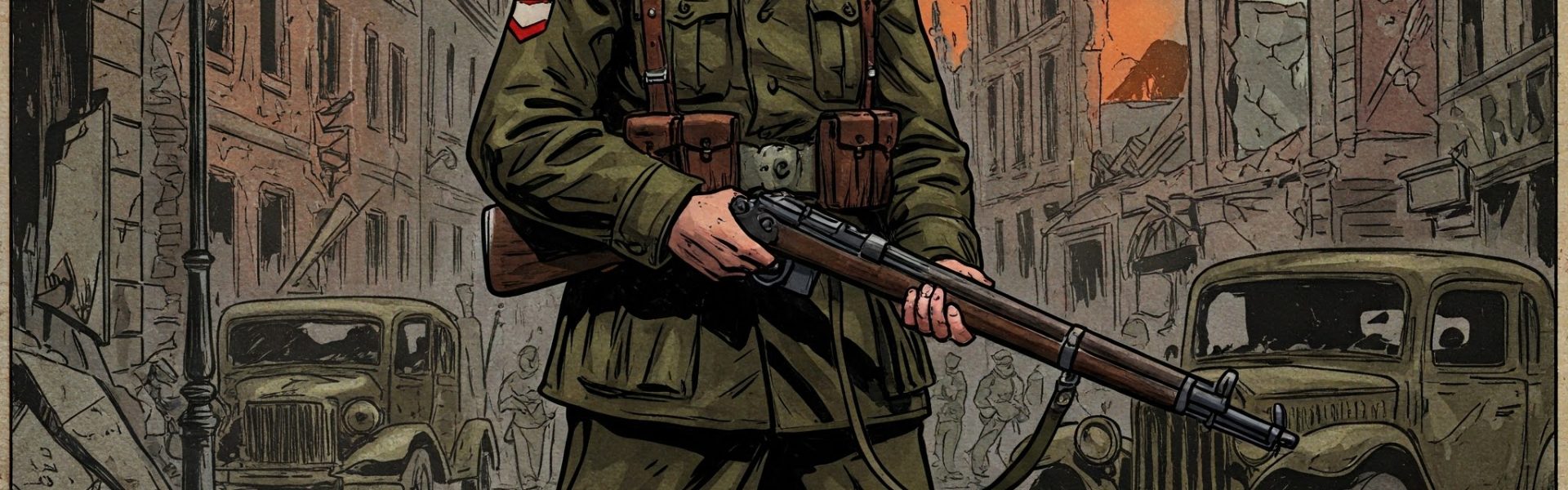
- Fighting for the City: On April 21, the first Soviet units reached Berlin, initiating street fighting.
- Units of the 1st Infantry Division named after Tadeusz Kościuszko participated in the fighting.
- The fighting was conducted for every building, every meter of street, and Soviet soldiers had to overcome numerous barricades, bunkers, and fortifications.
- Key points of resistance: the Reichstag, the Reich Chancellery, Hitler’s bunker.
- Fall of the Third Reich:
- On April 30, 1945, Adolf Hitler committed suicide in his bunker.
- On the same day, Soviet soldiers captured the Reichstag, hoisting a red banner on it.
- On May 2, 1945, General Helmuth Weidling signed the surrender document of the Berlin garrison.
Consequences of the Battle
- Losses:
- Red Army: over 80,000 killed.
- Wehrmacht and Volkssturm: estimated tens of thousands killed.
- The number of civilian casualties is difficult to estimate, but may have reached tens of thousands.
- Political Consequences:
- The capture of Berlin marked the final defeat of the Third Reich and the end of World War II in Europe.
- The battle contributed to the division of Germany into eastern and western parts and the beginning of the Cold War.
The Battle of Berlin was one of the most dramatic and bloody episodes of World War II. Its consequences had an enormous impact on the post-war order in Europe and on the entire world.
Of course, the Polish contribution to the Battle of Berlin is an important and often overlooked aspect of this historical battle. Polish elements in the Battle of Berlin, although perhaps not as widely known, are a significant part of the history of this operation. Here is an extended description with Polish threads included:
Polish participation in the Battle of Berlin:
- 1st Infantry Division named after Tadeusz Kościuszko: This formation, also known as the Kościuszko Division, played a significant role in the final battles for the capital of the Third Reich.
- Soldiers of this division took part in fierce street fighting, contributing to the capture of subsequent districts of Berlin.
- The 1st Infantry Division named after Tadeusz Kościuszko, under the command of Brigadier General Wojciech Bewziuk, was assigned to the Soviet 2APG.
- 1st Independent Mortar Brigade (1SBM): This was the first Polish unit to take part in the assault on Berlin.
- The 1SBM, commanded by Soviet Colonel Vasily Yurin, consisted of four regiments and, during the fighting for Berlin, was part of the 47th Army of the 1st Belorussian Front.